Rewired Expectations: What Electric Motors Are Teaching Us About How Cars Should Feel

Photo: Ogidya, CC BY-SA 4.0, via Wikimedia Commons
For generations, American drivers learned to read their vehicles through a set of deeply ingrained sensory cues — the rising growl of an engine climbing through its rev range, the momentary hesitation before a transmission found the right gear, the mechanical theater of a powertrain working visibly, audibly, and physically to deliver speed. These cues were not merely functional; they were cultural. They informed what performance meant, what driving felt like, and what enthusiasts celebrated.
Electric motors are quietly erasing that vocabulary and replacing it with something altogether different. The shift is not simply technological. It is perceptual, behavioral, and, for many drivers, deeply disorienting — at least at first.
The Paradox of Instant Torque
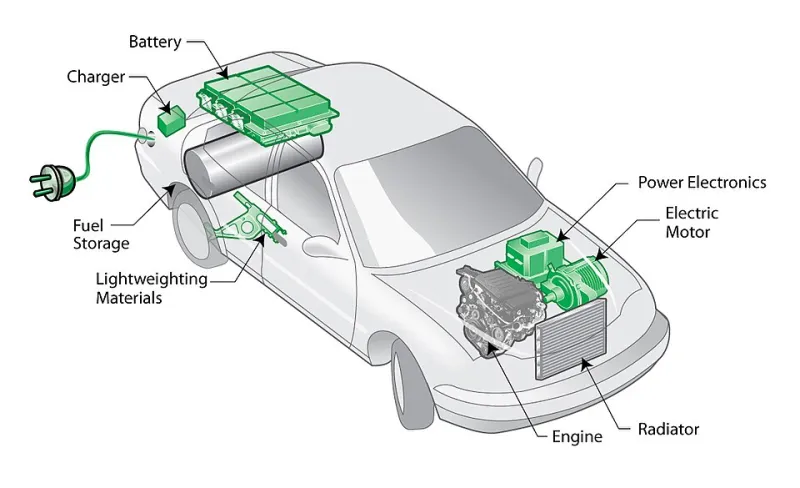
Ask most automotive engineers what distinguishes an electric motor from a combustion engine in terms of driver experience, and the answer comes quickly: torque delivery. A gasoline engine produces peak torque within a specific rev range, meaning the driver must manage throttle input, gear selection, and engine speed to access maximum thrust. An electric motor, by contrast, delivers its full torque output from a standing stop — instantaneously, without hesitation, and without the mechanical drama that traditionally accompanied serious acceleration.
This characteristic produces a sensation that veteran drivers often describe as unnatural. Vehicles like the Tesla Model 3 Performance, the Kia EV6 GT, and the Ford Mustang Mach-E GT can accelerate with a ferocity that arrives before the driver's nervous system has fully registered the throttle input. There is no buildup, no crescendo — only immediate, almost clinical thrust.
For performance enthusiasts conditioned by decades of internal combustion, this can initially feel less satisfying, even antiseptic. Yet data from owner surveys and automotive research firms consistently shows that most drivers — including longtime skeptics — adapt rapidly and come to prefer the electric motor's linear, predictable power delivery. The learning curve is real, but it bends sharply toward appreciation.
One-Pedal Driving: Unlearning the Brake
Perhaps no feature better illustrates the behavioral recalibration demanded by electric vehicles than regenerative braking — specifically, the one-pedal driving mode offered by most modern EVs. In this configuration, lifting off the accelerator triggers aggressive energy recuperation that slows the vehicle substantially, often to a complete stop, without any input from the brake pedal.
For drivers trained over years or decades to modulate speed through a combination of coasting and deliberate braking, the adjustment can feel counterintuitive. The foot searches instinctively for the brake. The absence of coasting — that familiar glide between throttle and stop — registers as missing, like a step that isn't there on a staircase.
Yet the efficiency argument for one-pedal driving is compelling. By converting kinetic energy back into stored electricity during deceleration, regenerative braking extends range meaningfully, particularly in urban stop-and-go conditions where a conventional vehicle bleeds energy continuously as heat through its brake rotors. Automakers including Hyundai, Chevrolet, and Rivian have invested substantially in refining regenerative braking systems to feel natural and progressive rather than abrupt, recognizing that driver acceptance is as important as energy recovery efficiency.
The broader implication is significant: electric vehicles are not merely replacing one powertrain with another. They are inviting — in some cases requiring — drivers to develop new physical habits and new cognitive frameworks for operating a vehicle.
Handling Dynamics in a Heavier World
Electric motors introduce another variable that reshapes vehicle dynamics: weight. Battery packs, particularly the large-format units required for competitive range, add substantial mass. The Rivian R1T pickup, for example, weighs approximately 7,000 pounds — considerably more than a comparable gasoline-powered truck. Even more compact EVs like the Chevrolet Equinox EV carry battery weight that their combustion counterparts do not.
Conventional automotive wisdom holds that weight is the enemy of handling. Yet electric vehicles complicate that equation in an instructive way. Battery packs are typically mounted low in the vehicle's floor, producing a center of gravity that sits dramatically lower than in a combustion vehicle, where the engine, transmission, and exhaust system distribute mass at varying heights throughout the chassis. This low, centralized mass distribution reduces body roll, sharpens turn-in response, and lends many EVs a planted, stable quality in corners that belies their weight penalty on paper.
Manufacturers have also leveraged the precision of electric motors to introduce torque vectoring systems — independently controlling power delivery to individual wheels — that actively manage understeer and oversteer in ways a single combustion engine cannot replicate. The Rivian R1T, the Audi e-tron GT, and the GMC Hummer EV all employ variants of this technology, allowing vehicles that would be dynamically compromised by traditional metrics to perform with surprising agility.
The Disappearing Soundtrack
Among the sensory changes wrought by electrification, none proves more emotionally contested than the absence of engine sound. The acoustic signature of a high-performance combustion engine — whether the flat-plane wail of a Ferrari V8 or the burbling exhaust note of an American V8 — functions as an emotional amplifier, translating mechanical effort into visceral excitement.
Electric vehicles offer something closer to silence punctuated by wind and tire noise. Some manufacturers have responded by engineering artificial soundscapes — BMW's IconicSounds Electric, developed with composer Hans Zimmer, and Hyundai's Active Sound Design system among them — that attempt to provide acoustic engagement without combustion. Reactions from drivers and critics remain mixed. Purists often find synthesized sound hollow; newer converts to EVs frequently report that they simply stop expecting sound and recalibrate their sense of performance around other inputs.
Federal regulations already require EVs to emit pedestrian-alert sounds at low speeds for safety reasons, but the broader question of whether electric vehicles need to sound exciting remains genuinely unresolved. It may ultimately be generational — a concern that diminishes as drivers who never formed an attachment to engine noise become the majority of the market.
Redefining the Performance Benchmark
The cumulative effect of these changes — instant torque, regenerative braking, low center of gravity, electric torque vectoring, and acoustic silence — is a vehicle category that performs exceptionally well by measurable standards while simultaneously challenging the subjective criteria through which performance has historically been judged.
Zero-to-sixty times, once the province of dedicated sports cars, are now achievable in family crossovers. Lap times at closed circuits increasingly favor electric platforms. Yet the question of whether electric vehicles are more or less engaging to drive remains genuinely contested, even among professionals.
What is not contested is the direction of travel. As battery technology matures, charging infrastructure expands, and a new generation of drivers forms its automotive expectations entirely within the electric era, the sensory and behavioral benchmarks that defined driving for the past century will continue to evolve. The internal combustion engine taught Americans what a car was supposed to feel like. The electric motor is beginning the long work of teaching them something new — and for a growing number of drivers, that lesson is arriving faster than anyone anticipated.